The costume parade was fun. The haunted-house decoration at the neighbor’s was “not even scary.” Then the lights go off, and suddenly your five-year-old is standing in the hallway whispering that there’s a pumpkin face on her wall and it’s looking at her.
This is the Halloween-week bedtime special: a child who handled the scary thing just fine in daylight, and meets it again, bigger, in the dark.
Why the picture follows them to bed
Young kids don’t store a scary image as “a thing I saw.” They store it as a thing that might still be around. During the day there’s noise and company and plenty to look at, so the picture stays quiet. At bedtime everything gets still, the brain starts replaying the day, and the vivid stuff comes up first: the skeleton on the porch, the mask at the party, the shadow your lamp casts on the closet door.
Telling her “it’s not real” rarely lands. She knows it’s not real, in the way she knows the stairs are real but still doesn’t want to look down them. What helps is making the picture smaller and more known, not arguing about whether it exists.
The routine: Name it, Breathe it, Light the spark
1. Name it, exactly. Ask her to tell you the picture in her own words, in a whisper if she likes: “The pumpkin with the big teeth.” Don’t fix it yet. A worry with a name has edges, and edges can be handled. A vague “something scary” has none, so it can be anywhere.
2. Breathe it soft. Hand on her chest, one slow breath in through the nose, a long slow breath out through the mouth, like blowing on warm soup. Do three together. This part is for the body, which is the thing that’s actually in alarm. Once the breathing slows, the picture loses a lot of its pull.
3. Light the spark. Now give her something to do that makes her the brave one. Have her pick a small light: a night-light, a flashlight she holds, or a pretend golden spark in her chest. Then try the shrink: “Let’s make that pumpkin as small as a button.” Or find the harmless version together: a jack-o’-lantern on a windowsill is a friendly glow, not a face. Kids who get to change the picture sleep better than kids who are only reassured.
Two things that quietly make it worse
Checking the closet five times. It feels kind, and it tells her there really was something to check. One calm look, one sentence (“all clear”), then back to the routine.
Skipping the next day. Mention it lightly at breakfast: “Remember how you made the pumpkin button-sized?” That turns one scary night into proof she can handle the next one. Over Halloween week, that matters more than any single bedtime.
Halloween week, in practice
Keep decorations at the front door out of the bedroom hallway if you can, dim the lights a little earlier than usual, and give the last ten minutes before bed to something warm and boring. A scary picture needs a busy mind to feed on, and a quiet one lets it fade.
What to say when she asks “but what if it comes back?”
It might, and that’s okay to say out loud. “If it comes back, you know exactly what to do. Name it, breathe it, light your spark.” You’re not promising the picture will never return. You’re handing her a tool she can use alone, and a child who has a tool at 8:30 p.m. stops needing you to stand in the doorway at 10.
If the same image keeps coming back night after night for more than a couple of weeks, or she starts avoiding her room during the day, that’s worth a quick mention to your pediatrician. For most kids, one scary week in October passes just as fast as the candy does.
This week’s comic
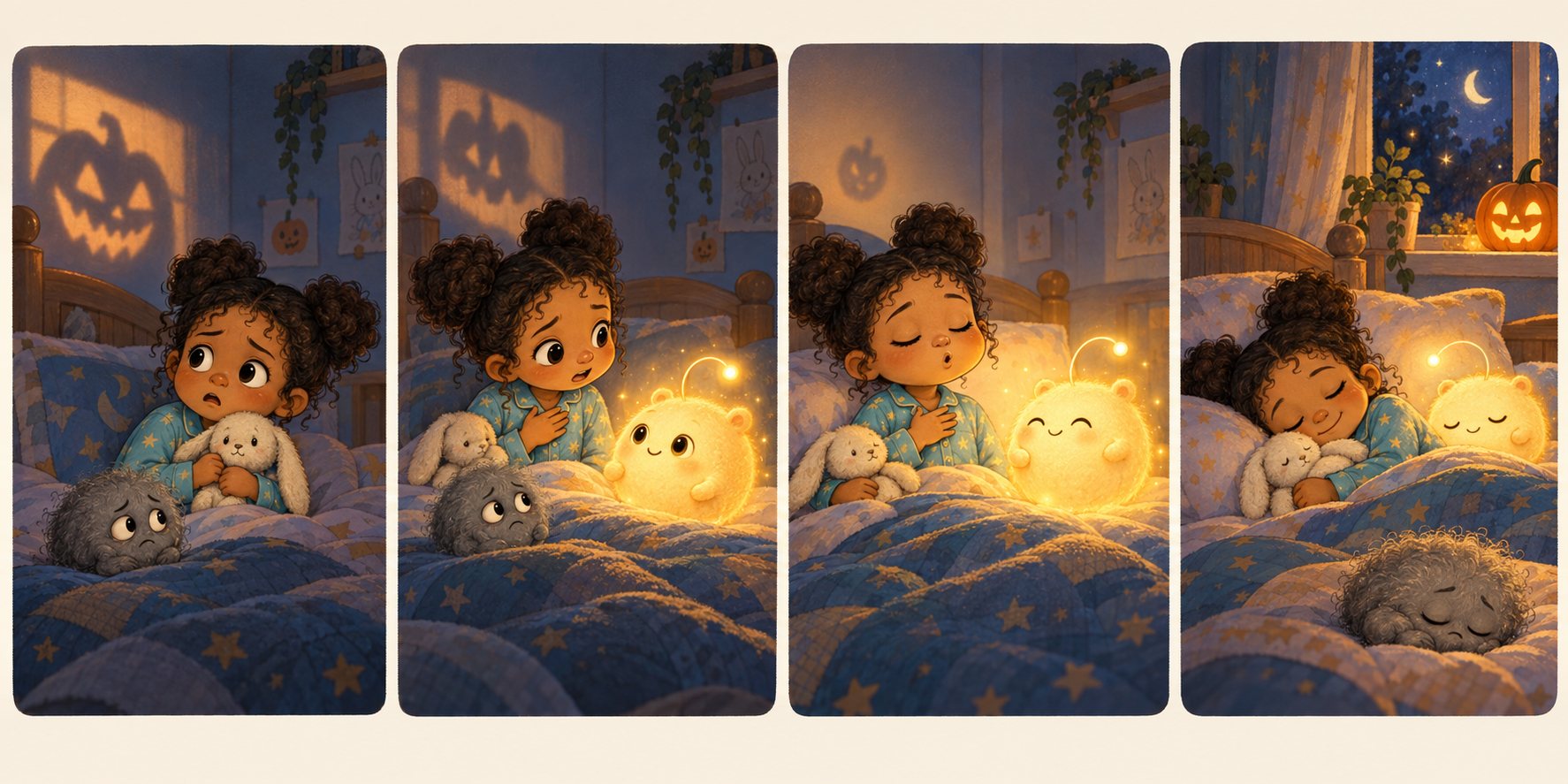
Mira & Lumo · a comic from Atlas Moon Publishing
The three steps come from the Mira & Lumo method, and The Brave-Enough Spark (Book 12) is the one about being scared and brave at once. If your child’s worries are more of the whispery, can’t-settle kind, The Whisper Worries is the place to start, and The Goodnight Glow is a gentle way to end a spooky day on something good. Browse the whole Mira & Lumo series, or see all 37 books across our three series.