The sun goes down twenty minutes earlier than it did a month ago. You have already said “five more minutes” — twice, generously, in a reasonable voice. It is now dark enough that you can’t quite see which kid on the climbing frame is yours.
You call again. Nothing. You walk over. And the child who has been having the single best hour of his week goes stiff, boneless and furious, all in the same second, because you have just ended the world.
Here’s the thing almost nobody tells you: for a big-energy kid, leaving is a harder skill than sitting still. And the tool most of us reach for — the time warning — is the one tool that doesn’t work on them.
Why “five more minutes” never lands
Three reasons, and all three are fixable.
Minutes aren’t real to a six-year-old. A child who can’t yet read a clock hears “five more minutes” as a mood, not a measurement. It means not now. It could equally mean thirty seconds or half an hour, so their body doesn’t start getting ready, because there’s nothing concrete to get ready for.
You’re shouting into a body at full throttle. A kid mid-slide is running on pure momentum, forty feet away, with wind and other children in between. The words technically arrive. Almost none of them get processed. That’s not defiance — it’s a brain that’s busy.
Last time, five minutes turned out to be negotiable. If the second “five more minutes” has ever existed at your house, your child has correctly learned that the first one is an opening offer. They’re not being difficult. They’re being observant.
The 3-step exit: Warn the body · Name the last one · Hand over the job
Takes about ninety seconds total, and works because it never asks a moving body to simply stop.
1. Warn the body, not the clock. Walk over. Get down to eye level. Put a hand on a shoulder or an arm — touch does what volume can’t. Then count in something they can actually see: “Two more turns on the slide.” “Three more pushes.” “One more lap and then the gate.” Turns, trips and laps are real. Minutes are not.
2. Name the last one — out loud, and mean it. When the last turn starts, say so: “This is the last one. After this one we walk to the car.” Then watch it happen and don’t hurry it — the last turn belongs to them, all of it. The word “last” only stays powerful if it’s true. Cave once and you’ll pay for it every visit for a month.
3. Hand over the job. This is the step people skip, and it’s the one that does the work. A body in motion needs somewhere to put the motion, so don’t ask for an off switch — give it a destination. Carry the water bottle. You’re in charge of the gate. Race me to the third tree. Now leaving isn’t the end of the fun; it’s the next assignment. Same energy, new direction.
Two things that make it worse
The surprise exit. Scooping up a kid mid-play with no warning teaches them that good things end without notice, so the smart move is to resist every single time. Ninety seconds of warning now buys you a year of easier goodbyes.
Negotiating from forty feet away. Every shouted “we’re leaving!” that isn’t followed by leaving trains your child to wait for the one that’s real. Say it once, up close, then follow through. Less talking, more walking over.
Give it two weeks
The first few times, expect a grumble on the way to the gate — that’s fine, and it isn’t failure. A grumble is a whole solar system away from a screaming, boneless drag across a parking lot.
What families notice first isn’t that their kid gets happier about leaving. It’s that leaving stops being a fight they have to win, and turns into a thing that just happens, the way it does for everybody else.
This week’s comic
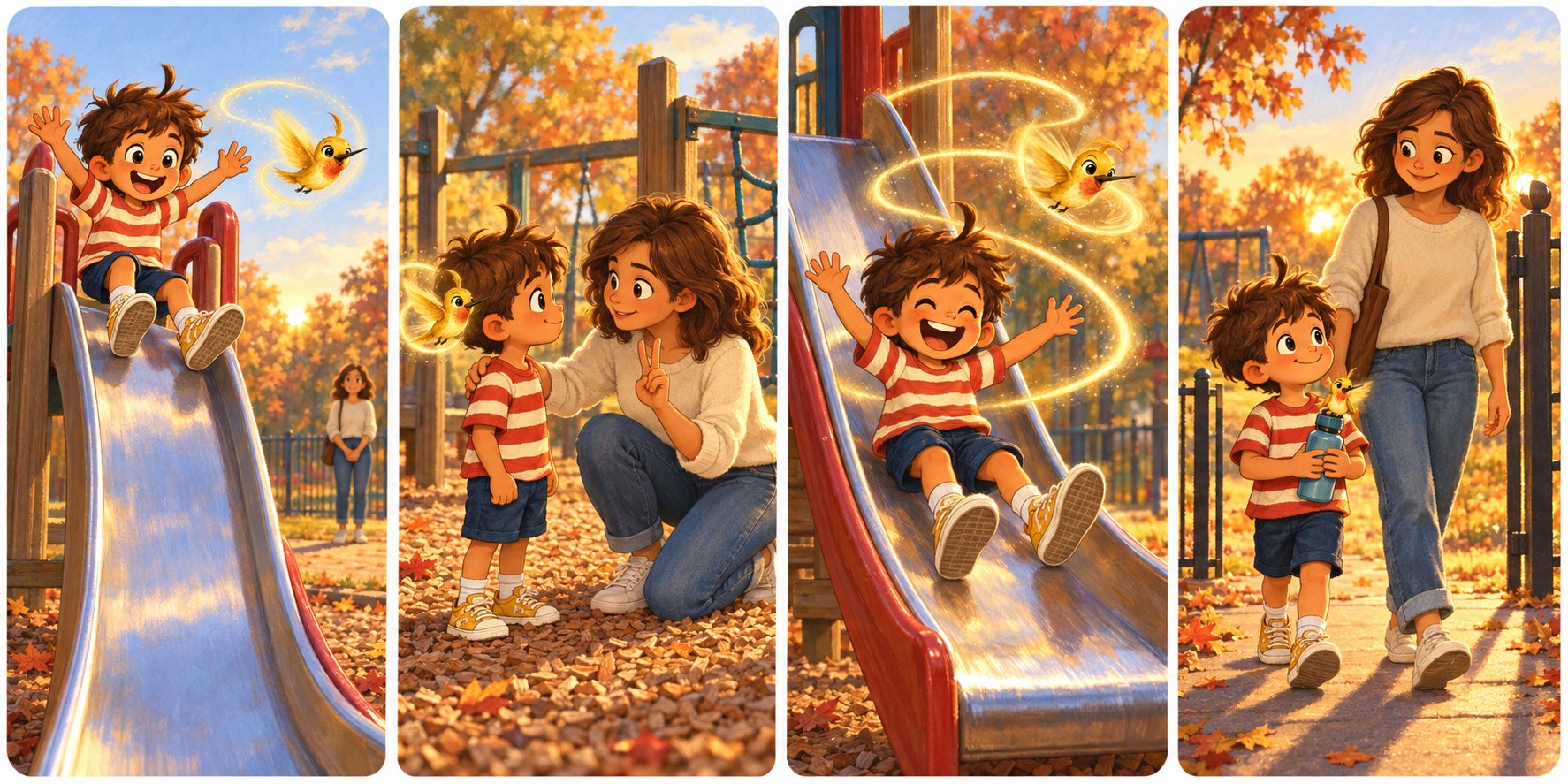
Finn & Zip · a comic from Atlas Moon Publishing
If this is your whole evening, it’s the whole plot of Time to Go, Finn, Book 9 of the Finn & Zip series for ages 4–8, where Finn learns the Countdown-Catch. When the fight is over a screen instead of a slide, Five More Minutes! teaches the Landing-Gear: five minutes means circle the runway, one minute means wheels down — pilots land, they don’t crash. And if the trouble is really the waiting in between, that’s Finn Hates Waiting. New here? Start with books for kids who can’t sit still, or browse all 37 books across our three series.