The costume was the easy part. He picked it himself, he wore it all week, and he was practically vibrating by the time you pulled up to the party. Then the door opened: music, a hundred kids, orange lights, a fog machine in the hallway, somebody’s plastic skeleton cackling every time you walked past. Within ten minutes your big-energy kid is either bouncing off the walls or standing very still with his hands over his ears, and neither one looks like fun.
If that’s your Halloween, nothing is wrong with your child. Parties are built for kids who can filter noise. Some bodies don’t filter; they just feel all of it at full volume.
Why Halloween is the hardest night for loud-feeling kids
A regular birthday party has one kind of noise. Halloween has everything stacked at once: flashing lights, masks that hide faces (so you can’t read who is friendly), scratchy costumes, strange smells, sugar, and a rule that it’s all supposed to be exciting. For a kid who already runs hot, excitement and overload feel almost identical inside the body. His chest goes tight, his voice gets loud, his hands get grabby, and from the outside it looks like misbehavior when it’s really a full tank.
You can’t turn the party down. But you can give him a way out before the tank overflows.
The plan: Signal, Nook, Zip Breath
1. Pick the signal before you go. In the car, agree on a tiny secret sign — a tap on his own shoulder works well, because nobody else notices it. It means “I need a break,” and the deal is that a tap is always honored, no questions, no “but you’re having fun!” A signal he trusts is a signal he’ll actually use, and using it early is the whole point.
2. Scout the nook in the first five minutes. Walk the space once together and pick the quiet spot: a hallway, a bottom stair, a coat room, the car if you must. Say it out loud: “If it gets loud, that’s our spot.” When he needs it, he doesn’t have to think or find words. He just goes.
3. Take a Zip breath. In the nook, sit down and put both hands on the belly. Breathe in slowly like a hummingbird easing into a hover, and out even more slowly, three times. You don’t need to talk it through. Dim the noise, lower your own voice, and let his shoulders drop. Two or three minutes is usually enough; then ask whether he wants to go back in, take a snack break, or head home. All three answers are fine.
One bonus step for the end of the night: once you’re home, skip the candy-pile negotiation for twenty minutes. Let him decompress with a bath, a snack with some protein, and a quiet book. Sorting loot can wait until tomorrow morning when his brain isn’t running on fumes.
What to skip
Skip “calm down” in the middle of the crowd — it’s never once worked in the history of parenting. Skip dragging him back to the dance floor to “give it another try” right after a break. And skip the post-party review of everything that went wrong. A kid who used his signal, found his nook and came back smiling did the hard thing, and that’s the thing to say out loud.
Leaving early is allowed, too. Forty good minutes beat two bad hours, and a kid who knows you’ll honor his limits is more willing to try the next party.
This week’s comic
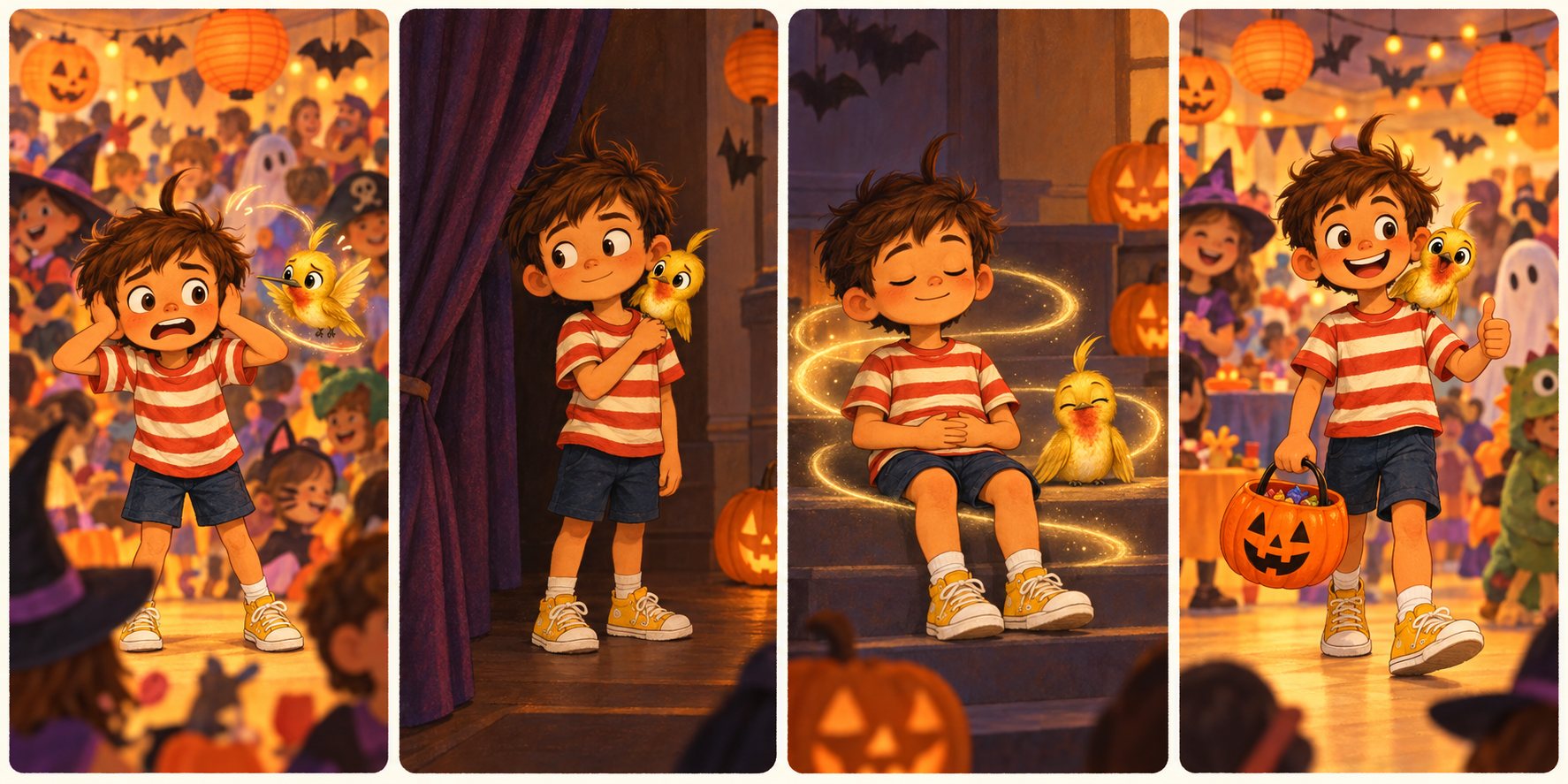
Finn & Zip · a comic from Atlas Moon Publishing
The Signal, Nook, Zip Breath reset comes from Too Loud for Finn, part of the Finn & Zip series for big-energy kids, ages 4–8. If waiting rooms and long lines are the harder part of your night, try Finn Hates Waiting; for the “time to go” moment at the end of the party, Time to Go, Finn has the exit routine. New here? Start with books for kids who can’t sit still, or browse all 37 books across our three series.